Call To Order

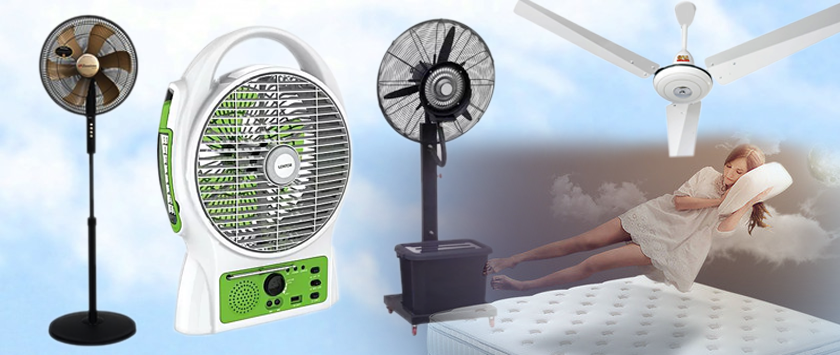
Fans circulate the air and keep it in motion, maintaining a fresh breeze that cools as well as keeping humidity levels in check. Fans can be thought of as low pressure air pumps that utilize power from a motor to output a volumetric flow of air at a given pressure.
Features of fans
Fan Blades
The blades are one of the most identifiable features of most fans. These are the paddle-shaped objects that spin and move air through the fan. They're angled to carry air from one point to another. Some fans have a switch that allows users to control the direction of the airflow while others blow air in only one direction based on the angle of their blades.
Center Hub
The hub is located in the center of the fan blades. It is the device that connects the motor to the fan blades, without it, your fan would simply not work as the blades and the rest of the fan would be two different pieces. In other words, the hub keeps everything together.
Fan Motor
The motor is what makes an electric fan go. Whether it's a ceiling fan, a window fan, a desk fan, a computer fan or an automotive fan, they all need power to keep turning and moving air, which typically comes from a motor. Ceiling fan motors are housed above the hub of the fan in special motor housing. Box fans and desk fan motor housing units are typically located behind the hub. Computer fans and automotive fans may or may not have motors separate from the machinery they service, and some models rely on the car or computer's own power supply to turn the fan.
Power Switch
Stating that electrical fans run on electricity may seem like an over-simplification, but electrical components must be present in order for the fan to work. When a switch is flipped, the circuit is whole and power can run from an outside power source to the motor to power the fan and make it rotate. Not all fans have an obvious switch. Fans found in computers start when the computer starts; the switch is thrown when the power is supplied to the whole unit.
Protective Guard
Fan guards protect both the fan and the user from damage. Not all fans have a guard. Those with a high probability of coming into contact with outside elements – including but not limited to vegetable matter, additional mechanical elements or the user's skin will have a guard. Ceiling fans typically do not have a guard due to the low chance of encountering a person or object. Computer fans may or may not have a guard to keep the blades from interfering with other pieces in the casing. Automotive fans may or may not have a guard, depending on the make and model of the car and the function and location of the fan.
Fan Mount
The mount keeps the fan where it's positioned. Most fans are mounted with screws and brackets, whether it is to an engine, a computer processing unit (CPU), a ceiling or in the case of a window or desk fan to the stand that holds the fan.
Electrical Wiring
Without wiring, a fan could not access and use electricity to its full potential and would have to rely on natural stimuli, such as wind, to move, which would be difficult indoors or inside machinery. A wall plug for a desk fan converts energy flowing into a house's outlet into a medium the fan can use. Wiring carries the electricity throughout the fan to the motor and to the blades to make them turn.
Bladeless Fans
There are newer fans on the market that are a little different from traditional fans – namely, they're bladeless, so they lack fan blades. Instead, they use newer technology that draws air into the machine and sends it out using principles of low pressure that amplifies the airflow for a bladeless fan experience.
Functions of Fans
- Keep the engine coolant or antifreeze from rising above its operational temperature.
- Fans are in residential apartments as the primary source of cooling. They are also used to dry clothes during the rainy season.
- In cold regions, fans are equipped with reverse speeds, which circulate the hot air in the room.
- In small scale industrial sectors, fans are used in the drying process.
- Fans are also used in frozen goods industry to circulate air evenly.
- Fans are the primary source of cooling in most schools, hospitals, colleges and factories.
- Large fans are used in shopping centres, railway stations & showrooms.
Different Fan Styles
Here's an overview of some of the most popular types of electric fans and what they're generally best suited for:
Table Fans -Small, compact size allows for easy transport.Suitable for cooling personal spaces and can be placed on floors, desks, tables, or countertops. Affordably priced and offers economical cooling.
Pedestal Fans- Adjustable height for convenient operation. Many have oscillating heads for more air distribution. Great for cooling large rooms.
Window Fans- Brings in fresh air and draws stale air out.Window mounting saves valuable table and floor space. Suitable for cooling areas where leaving a window open isn't enough.
Wall Mount Fans- Creates a comfortable environment in areas with limited floor space. Provides powerful air circulation. Great for industrial settings such as warehouses, workshops, garages, factories, and more.
Floor Fans- Provide powerful airflow and ventilation at foot level. Ideal for areas where mounting a fan on a wall or ceiling isn't feasible. Great for cooling homes, warehouses, and offices.
Tower Fans- Thin, verticle design allows it to fit into small, compact spaces. Less likely to tip over than a top-heavy pedestal or stand fan. Great for cooling homes and offices; also quiet.
Ceiling Fans- Makes rooms feel significantly cooler by providing a circulatory breeze. Can slash heating costs when used in the winter. Comes in a variety of styles to match your home's decor and furnishings.
Box Fans -Extremely versatile, can be placed on the floor or in an open window (similar to an AC). Helps circulate indoor air and prevents it from getting stagnate. Suitable for most home cooling needs.
Misting Fans- Misting nozzles create a fine, cool mist which evaporates and creates a chilling breeze. Simple to assemble and incredibly energy efficient. Ideal for use in outdoor areas such as backyards, patios, and athletic fields.
Industrial Fans and Blowers- Usually constructed of durable metal or steel. Typically best suited for high-volume, high static pressure applications. Used for heat stratification, ventilation, and preventing air stagnation.
Decorative Fans- Cools off rooms in style. Come in a variety of colors, designs, and styles to match your home's decor. Offer a refreshing change from traditional plastic electric fans.
Bathroom exhaust Fans- Greatly reduces/eliminates problems created by excess moisture. Prevents paint from peeling, doors from warping, and accumulation of mold spores. Eliminates and exhausts stagnant air and odors out of bathroom.
Kindly click on the links and image below to place your order
https://www.deluxe.com.ng/product-category/fans
www.deluxe.com.ng
Category